

Performance-Focused Horsemanship
Developing Soft, Responsive, & Versatile Horses
Lexy Nuesch Horsemanship develops soft, responsive, versatile horses through a highly involved training program built around thoughtful foundation work, real-world experience, individualized care, and owner education. The goal is a horse whose education holds together in the arena, on the ranch, down the trail, and in the performance arena.

More Than Just a Training Stay
Sending a horse to training should be about more than putting rides on it and picking it up a few months later. At Lexy Nuesch Horsemanship, the program is designed to develop the whole horse while keeping the owner connected to the process along the way.
That means building a strong foundation, advancing the horse as it is ready, applying that education outside the arena, paying attention to the horse’s day-to-day care and management, and giving owners meaningful opportunities to learn throughout the process.
The goal is to develop a horse that can carry its training into different situations, while also giving the owner a better understanding of how to continue that progress once the horse goes home.
The Four Pillars of the Lnh Training Program
1. Education
Groundwork, Foundation, & Advancement
Groundwork is an important part of my program. It gives me a chance to fill in holes, establish a line of communication, learn how the horse responds to pressure, and prepare it both mentally and physically before moving into ridden work. From there, the initial riding foundation is about getting the horse confidently traveling forward at the walk, trot, and lope on a loose rein, learning to steer, developing lateral and vertical softness, and learning to stop and back. Once those basics are consistent, the work can progress into greater softness, responsiveness, body control, balance, and refinement through the head, neck, shoulders, ribcage, and hindquarters as the horse is ready.
.jpg)

2. Experience
Real-World Exposure, Miles, & Application
Arena work is an important part of developing a horse, but I want that education to travel beyond the arena. Once a horse is mentally and physically ready, we begin taking those skills into the real world through outside miles, pastures, gravel roads, creeks, cattle, hauling, and other new environments. Those experiences help build confidence, maturity, and the ability to think through pressure in ways that cannot be fully recreated inside an arena. The goal is for the same softness, responsiveness, and control we develop at home to continue to hold together whether the horse is on the ranch, down the trail, or eventually stepping into the performance arena.
3. Care
Horse Care, Nutrition, & Management
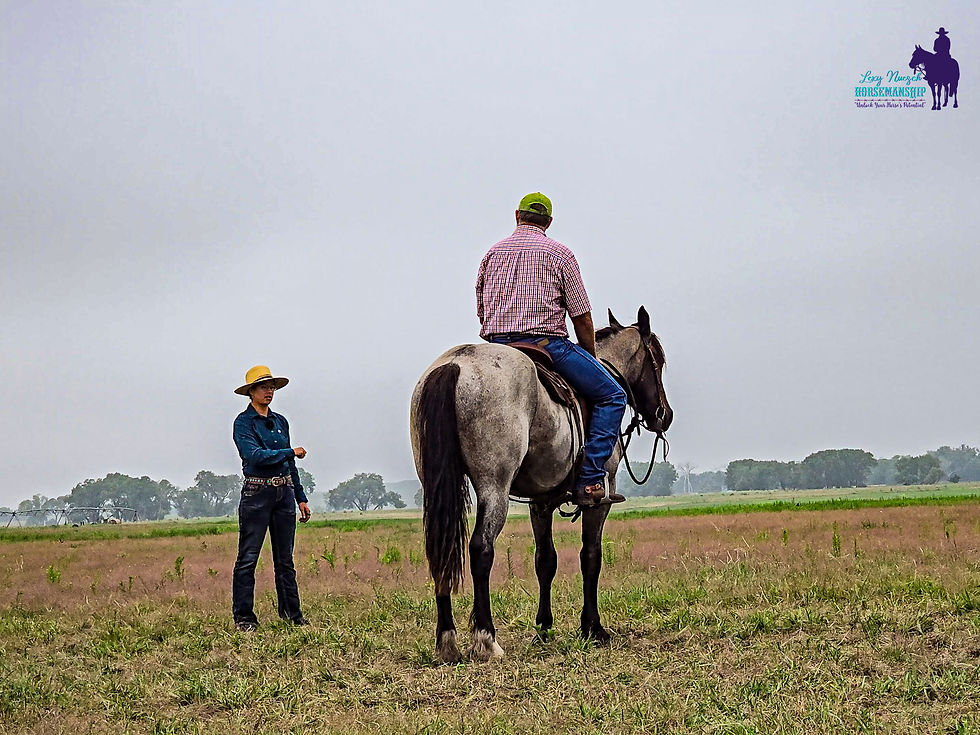
A horse’s training is influenced by much more than what happens during the ride. I am personally involved in each horse’s day-to-day care, from feeding and grooming to trimming, saddling, conditioning, and general management. That gives me the opportunity to notice the small things, including how a horse feels physically, how it behaves during routine handling, and whether something outside the training session may be affecting its progress.
Nutrition, hoof care, conditioning, and overall management are all considered as part of the horse’s development while it is here. I want the horse to feel and function as well as possible so the training has the best chance to progress in a productive way.

.jpg)
4. Owner Involvement
Owner Communication, Education, & Support
I want owners to have a clear understanding of what is happening with their horse while it is in training and meaningful opportunities to learn along the way. Regular updates, photos, lessons, Mini Clinics, and other educational opportunities are built into the program so owners can stay connected to the process and better understand how their horse is being developed.
Those opportunities are strongly encouraged, but ultimately it is up to each owner to take advantage of them. The more an owner understands about their horse’s education, timing, responses, and areas that still need work, the better prepared they are to continue that progress once the horse goes home.
Who This program is for
The LNH training program is best suited for owners who value thoughtful development, are willing to give their horse the time it needs, and want more than a short-term tune-up or basic colt start.
I most enjoy working with young horses, horses that need advancement, ranch and trail horses, ranch versatility prospects, and selected horses that may benefit from show or performance experience. The program can also be a good fit for horses that already have some education but need holes filled in, greater softness and body control, or a more complete foundation before moving forward.
Just as importantly, the owner needs to be a good fit for the program. I work best with people who are invested in their horse, open to learning, realistic about what their horse needs, and willing to trust me to do the job I have been hired to do.
Training Pathways
Not every horse enters the program at the same stage. Some are coming in to be started under saddle, some need groundwork and handling before ridden work begins, and others already have a foundation that needs to be strengthened or advanced. The pathway depends on where the horse is starting and what we are ultimately working toward.
.jpg)
Young Horse Handling & Groundwork
Designed for weanlings, yearlings, and horses that are not yet ready for ridden work but would benefit from a more complete handling and groundwork foundation.
The focus may include leading, tying, yielding to pressure, grooming, picking up feet, preparation for trimming, desensitizing, groundwork, loading, and other practical skills that help prepare a young horse for the next stages of its education. These programs are generally shorter than the ridden training program and are tailored to the horse’s age, current handling, and goals.
Young Horse Development
Designed primarily for unstarted 2- and 3-year-olds entering the full ridden training program. The focus begins with groundwork and preparation, then progresses into a solid riding foundation with forward movement, steering, stopping, backing, lateral and vertical softness, outside miles, and continued advancement as the horse is ready.
This pathway carries the standard 120-day minimum, although many young horses benefit from additional time when the goal is to continue beyond the basics and build more consistency, body control, experience, and refinement.
.jpg)

Foundation & Advancement
For horses that are already started under saddle but need their foundation strengthened, holes filled in, or their education taken further.
Depending on the horse, that may mean revisiting groundwork and basic ridden responses before progressing into greater softness, responsiveness, body control, balance, outside application, and more advanced maneuvers. This pathway is a good fit for horses that have the basics but are not yet as complete, refined, or versatile as the owner would like them to be.
Performance Development
Performance Development is for horses being intentionally prepared for the performance arena, with my primary focus moving toward ranch versatility and cowhorse.
Horses entering this pathway must first have completed the LNH Young Horse Development program or gone through Foundation & Advancement with me. That prerequisite is intentional. Before I begin specializing the work toward competition, I want to know the horse has the broader foundation, softness, body control, outside experience, and understanding that the performance work will be built on.
Performance Development requires a six-month minimum commitment. That additional time gives us room to continue refining the horse, introduce more specialized work, haul, expose the horse to different environments, and incorporate showing where appropriate without sacrificing the broader education underneath it.


Development Over Deadline
For ridden horses, training begins with a 120-day minimum. Four months gives us enough time to establish a solid foundation and begin moving beyond the basics, but I do not view Day 120 as an automatic finish line or pickup date.
Earlier in my career, I did the more traditional 30-day colt starts, and that experience is a big part of why my program looks different today. In a shorter stay, there is only so much time to get a horse started, establish the basics, and begin building consistency before it is time to go home. I found that I wanted more time to let those lessons become habits, move beyond simply getting the horse riding, and begin developing the softness, body control, outside experience, and refinement that I value now.
Every horse develops at a different rate. Depending on where the horse starts, its temperament, the goals we are working toward, and how the training progresses, I may recommend additional time. Many horses benefit from five or six months, especially when we have the opportunity to continue developing softness, body control, consistency, outside miles, hauling experience, and more advanced work rather than stopping just as those pieces are beginning to come together.
I am not interested in seeing how much I can cram into a set number of days simply to check boxes. The calendar is part of the conversation, but the horse in front of me has a much bigger say in how the training progresses. My preference is to give each horse enough time to build consistency and continue advancing without rushing the process.
The 120-day minimum applies to ridden training. Weanlings, yearlings, and horses entering a groundwork-only program may be accepted for shorter stays depending on the horse and the goals.


Performance with Purpose:
Performance & Show Development
Performance work is becoming an increasingly important part of my program, but I do not believe a horse has to be a dedicated show horse for that work to be valuable. Asking a horse to perform with greater precision can expose holes in softness, responsiveness, body control, balance, and mental acceptance that may not show up during easier everyday riding.
The foundation and advancement work in my program can support horses headed in a variety of directions, including ranch riding, 4-H, barrel racing, and other performance disciplines. My own focus, however, is moving more specifically toward ranch versatility and cowhorse, and those are the arenas where I expect to be most active with both my own horses and select client horses.
For the right horse and owner, showing can become part of the development process. Competition gives us another opportunity to see how well a horse can carry its education into a new environment and handle the added pressure that comes with being asked to perform away from home.
I am selective about the horses I take on specifically for showing, and I want the goals to be realistic for the horse, its current level of education, and the amount of time available. My focus is on creating a good experience, continuing the horse’s development, and preparing it as thoroughly as possible rather than promising a particular placing or outcome.
.jpg)


Owner Education:
Lessons & Mini Clinics
One of the biggest challenges in horse training is transferring the horse’s education back to the owner. I can ride a horse consistently for several months, learn where it gets sticky, how much pressure it takes, when to wait, when to follow through, and how he tends to handle pressure, confusion, and new situations. The owner has not had the benefit of those hundreds of small conversations.
That is why owner education is built into the LNH program. Included monthly lessons give owners opportunities to come out, see what their horse knows, ask questions, and begin learning how to use the same foundation themselves. I also offer two 2-day Mini Clinics during the horse’s stay, one prior to pickup and one at pickup, which allow us to spend more concentrated time together without trying to cram everything into one lesson on pickup day.
Just as importantly, these sessions give me the chance to watch the horse and owner together. Every rider has different timing, feel, balance, habits, and body language. Seeing that combination before the horse goes home can show me things I may never encounter when I am the one riding, and I can take that information back into the training.
These opportunities are included because I believe they can make a significant difference in the transition home. Owners are strongly encouraged to take advantage of them, but ultimately each person decides how involved they want to be in that part of the process.


The Next Step
If the LNH training program sounds like it may be a good fit for you and your horse, the first step is to complete a Training Application. The application gives me a chance to learn more about your horse, where things currently stand, what you are hoping to accomplish, and whether the program seems like the right fit before we move forward.
From there, you'll schedule a Training Discovery Call. The call is a chance for us to talk about your horse, your goals, the training program, timeline, investment, and any questions you may have. It is meant to be a straightforward conversation, not a high-pressure sales call.
If we both feel the program is a good fit, the next step is to reserve a training spot, complete the training agreement, and begin preparing for your horse’s arrival.
Frequently Asked Questions
Frequently Asked Questions
FAQ
The Answers You Need
Lexy Nuesch Horsemanship is not your average training program. Our ‘program’ is based on each horse, its needs, & your goals. We work with your horse from where they are each day with those goals in mind. Our goal is for your horse to leave more confident, relaxed, supple, responsive, & mentally willing & in better physical & mental condition not only due to our training program, but also thanks to our unique nutrition & horse health program. Lexy strongly believes in the importance of a strong foundation, building understanding & confidence through a wide variety of experiences, & maintaining owner involvement throughout the education process. We make no guarantees as to how far your horse will progress during your time with us, but we DO guarantee that we will do our very best to help your horse progress with your goals in mind. Throughout their time with us, the particulars of what we do with your horse will most certainly be geared towards your long-term goals. Arena work is valuable as it helps a horse become more mentally malleable, but we believe in building purpose outside of the arena. Therefore, we get out and work up and down hills, go through water crossings, push cattle, cross bridges, investigate ‘scary’ objects, open gates, & more. So whether you’ve got a young horse to be started or restarted, a ranch horse, reiner, barrel horse, trail horse, or any other discipline, we’ve got the tools and knowledge to help you & your horse & look forward to the opportunity to work together.
How would you describe your ‘training program’?
Yes. Below is are references we welcome those seeking outside opinions of our services to contact.
Jennifer Day Smith, Knotty Equine
308-660-9633
Brenda Sedlak
402-672-1451
Shanna Schulz
402-429-9686
Absolutely not!
We're not producing 30, or even 60-day wonders here at Lexy Nuesch Horsemanship. If you want things done quick, cheap, & not necessarily well, there are plenty of people who will buck'em out for $500 a month. Just remember, you get what you pay for.
Do you accept horses for shorter periods of time?
Documents Needed:
-
Current Coggins
-
Current Vaccination Record (within the last six months)
-
14-Day Health Certificate with horse's temperature noted
1 Month Before Arrival:
• Have your farrier trim your horse if possible
• Assess your horse's gut health (checking for the possibility of ulcers or other gut health-related issues) & treat if necessary.
• If a mare, we highly encourage you to have a uterine & urine culture done & any infection treated before arrival.
What do I need to do with my horse before sending them to you for training?
Yes. We highly encourage owner involvement while your horse is in training. So much so that we offer lessons for FREE while your horse is in training. We only ask that you schedule your visits with us as our schedule has us tending to many responsibilities.
Yes. With enough notice, we can arrange our training horses' schedule to make sure you can see your horse at work during your visit.
Our horses in training are worked a minimum of 5 times per week, weather permitting.
On average, our horses receive a minimum of 1 hour dedicated to progressing their education each day. Some days their session(s) could last greater than 2 hours, while others may be 45 minutes. We consider the time you are paying for, but our focus is on your horse's education. The time they need each day varies, & we know horses have no concept of an agenda. Also, our education goes beyond their' sessions.' We take the time to work with them when they are getting groomed, being washed, etc. While those opportunities might seem minute at first glance, they are substantial to your horse's education & encourage positive habits, behavior, & understandings.
For the first few days to the first week, your horse may be penned by themselves as we make sure they are not going to show any signs of sickness. Once your horse is settled in, they will get turned out with 1-4 appropriate pen mates. Depending on the conditions & time of year, horses are kept in a dry lot with 24/7 access to a large round grass bale in a HayChix hay net or turned out on pasture. If conditions allow, we offer maximum turn out to our horses, weather dependent. When weather is optimal, horses could receive 20-22 hours of turn out, the other time consisting of being worked & fed.
How much turn ouT will my horse get?
No. We have developed a nutrition program around our hay & D&D Nutrition products that works with our training program. The grass hay that is fed to your horse is grown right here on the ranch. We provide alfalfa in the form of D&D Nutrition's AlfaLux alfalfa cubes & feed their "Better than the Best" Magnify, a forage-based high-fat concentrate feed, & Oh-Mega-Goodness (OMG), a high-fat flaxseed-based supplement. Because we are located in the great SANDhills of Nebraska, horses receive a monthly dose of Psyllium Powder. We will make sure your horse is taken care of like a champion, from bone & joint supplements to gut health/ulcer prevention & relief!
STIPULATION: If your horse is on a veterinarian-prescribed supplement, such as for soundness or necessary for maintaining a healthy life, we can undoubtedly tailor to these needs.
Horses naturally graze for 17 hours per day on average. We offer maximum turn out to our horses as long as the conditions & time of year allow. When our horses are dry lotted, they still need access to forage. We use Hay Chix Hay Nets to keep our horses grazing even if they are not on pasture. These nets are paired with Century Horse Feeders (safe for horses with shoes). From large round bale nets that lengthen the time their hay lasts while not decreasing their intake to nets used while horses are tied, we have a solution to keep your horses grazing around the clock. One of the prominent reasons we love these hay nets, besides reducing waste, is that they help promote a healthy gut. Having hay in their stomach around the clock decreases the risk of ulcers, particularly in horses that are in work.
Why do you use Hay Nets?
No, we have all of the equipment that we’ll need to train your horse.
Yes! We highly encourage owner involvement while your horse is in training. In fact ALL LESSONS ARE FREE while your horse is in training!
Yes. We have an open-door policy for those wanting to come and see the facility and horses, as well as watch Lexy work horses. This goes for not just those looking to send a horse into training, but for anyone! The only thing we ask is that you schedule your visits with us before arriving at our ranch. While this is our place of business, it is also our home where we enjoy our privacy; we will not work with anybody who shows up unannounced.
No.
Do you offer discounts for multiple horses in training?
Currently, Lexy doesn't like to take on any more than five horses at a time, and we refuse to cheapen our work to put quantity over quality. Because of that, training spots are limited & are often booked six months to a year or more in advance.
How many horses do you work with at a time?
Yes. We offer sales and consignment services to owners with horses in training. For more information regarding these services, don't hesitate to contact us for more info!
Lexy has worked successfully with a plethora of horses both on the ground & under saddle with ‘spooking’ issues. Often, we find horses are lacking confidence more than anything or are experiencing a pain-related issue. While some horses may have confidence issues with specific objects such as bridges, tarps, flags, etc., some are naturally more wary & unsure. The best way we know to help these horses, after being checked out by Jennifer Day Smith of Knotty Equine, is to build their confidence.
For general health care & for emergencies, we utilize Sandhills Animal Health Center, located 19 miles down the road from us. For lameness, reproduction, and other needs that require a vet, we call on Dr. Brad Johnson of Norfolk Veterinary Clinic. We maintain a strong working relationship as well as friendship with each of our veterinarians.
Yes. Sandhills Animal Health Center is just 19 miles away. We have a great working relationship with Dr. Stephens, & our trailer is readily available in case of an emergency.
Lexy trims all of the horses in training with us. Horses in training are put on a 4-8 week trimming schedule.
When Lexy is not working horses on the weekends, she can often be found in Northeast Nebraska working on some of her 45+ trimming client horses.
Owner involvement during training is of the utmost importance to us. Therefore ALL LESSONS are FREE while your horse is in training with us!
THEN, after you head home, we welcome you to join us at a clinic or schedule private lessons to continue your progress with your horse.
Yes. All horses are required to receive 90 days of work, not just stay for 90 calendar days. Horses are required to stay for at least 120 calendar days to account for days of rest & inclement weather.
Do you have a minimum number of days that you'll take a horse on for?
The Lexy Nuesch Horsemanship Program is based on days of work over calendar days. Horses are required to receive 90 days of work & are expected to stay for at least 120 days to reach that point. Progress can be made a little quicker once a foundation is in place should your horse be chosen to continue into the Intermediate/Advanced phases of the Lexy Nuesch Horsemanship Program.
Is your program based on calendar days or days of work?
Yes.
Do you accept stallions?
Absolutely not!
We're not producing 30, or even 60-day wonders here at Lexy Nuesch Horsemanship. If you want things done quick, cheap, & not necessarily well, there are plenty of people who will buck'em out for $500 a month. Just remember, you get what you pay for.